Showing posts with label sampling. Show all posts

Thursday, April 14, 2016

Monitoring ascidians in the Venetian Lagoon

by Maria Casso

A wood pile dolphin, full of benthic organisms, and half eaten by wood-boring species.
Marco and the fog during the sampling.
The Benthic Ecology research group from the Istituto di Scienze Marina, ISMAR (Consiglio Nazionale delle Ricerche, CNR), placed in the Venetian Lagoon, is hosting me for a 3 months research stay. They focuses on ecology of coastal transitional ecosystems, specially benthic communities. More recently, they are interested on wood-boring marine organisms (shipworms and gribbles). This is very important in a place like the Venetian Lagoon as it has a large wooden maritime cultural heritage.

The aim of my stay in Venice is to study the invasive ascidians, which grow on top of those wooden marine structures. To do this, yesterday we went to a field trip around the Venetian Lagoon with Davide Tagliapietra, Marco Sigovini and Irene Guarneri. It was foggy in the beginning but more sunny at the end of the sampling. The objective of the field trip was to determine the distribution of some invasive ascidians and to collect samples for aquaria experiments.


Wednesday, November 18, 2015

Sea stars, Sampling & Sun

by Maria Casso

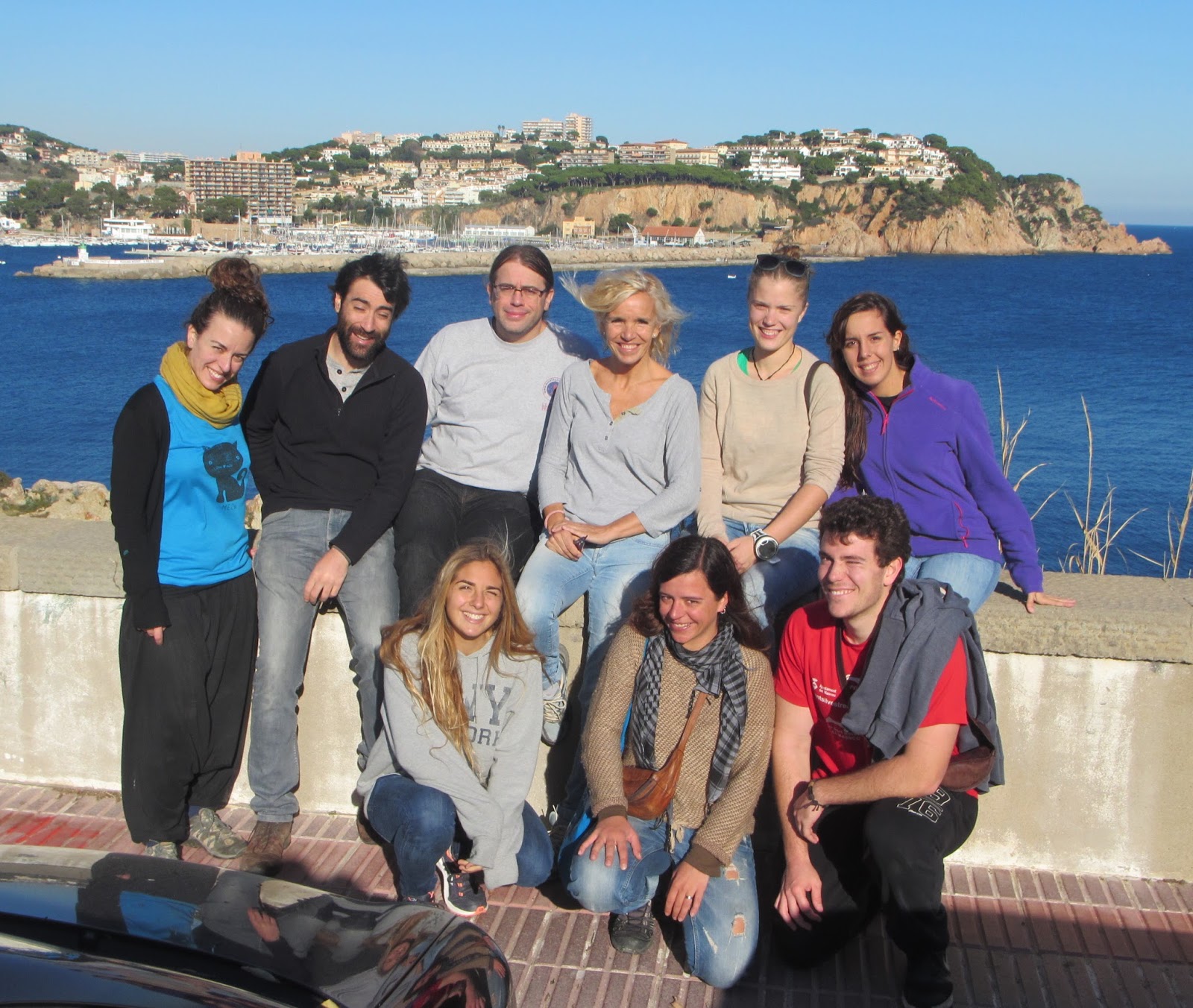
Yesterday we went to Sant Feliu de Guíxols, a locality situated on the Costa Brava. We sampled some sea stars by scuba diving, from surface to 20m depth.

We were very lucky because the day was sunny and the sea was oddly calm. It is a beautiful spot, but usually, at this time of year is very difficult to find such good weather conditions. Moreover, the water was warmer than we expected (18ºC at 12m and 16ºC at 20m depth).


Wednesday, November 4, 2015

Monitoring invasive ascidians at Ebro Delta

A nice view of the bivalve culture area.
by Maria Casso

Today we went to the Ebro Delta, for monitoring the invasive ascidians at the oyster and mussel culture structures. After a week of stormy days, we had a sunny and calm monitoring day.

We want to thank the Institute of Food and Agricultural Research and Technology (IRTA) for providing the boat and skipper and collaborate in this monitoring.


Víctor Ordóñez writting down the observations.
Maria Casso and Jose Luís Costa (IRTA).


Monday, July 20, 2015

ChallenGen at the 8​th International Tunicate Meeting (Aomori, Japan, 13­-17 July, 2015)

by Xavier Turon

Ascidians (Halocynthia roretzi) exhibited at the meeting venue... Can you believe that Japanese people eat them and consider them a delicacy?... I tried, between us, it is disgusting for my western taste.
The International Tunicate Meeting was held this year in Japan. I attended it and presented an oral communication about “Utility of the metabarcoding approach for the determination of tunicate in environmental DNA samples” (with Owen, Cruz, Magdalena, and Iosune Uriz).

I was happy to present in the first morning of the meeting, and could thus relax for the rest of the sessions. The meeting was very interesting, particularly the final discussion about the correct names of the species in the complex C​iona intestinalis.​ It seems that the species whose genome we sequenced, whose development has been studied all over the world, one of the best investigated invertebrate species, should be called C​iona robusta! ​I was called in as an expert taxonomist (an endangered species, btw) and had my saying on it, not to the likings of everyone, to be honest. I guess the controversy will continue for some time.

I also took advantage of my trip to sample D​idemnum vexillum​ in its native area. Dr. Gretchen Lambert was kind enough to give me some samples from the South collected during a pre­meeting course. I could collect myself in the Aomori Marine Station thanks to the help of Dr. Gaku Kumano. Overall, it was an enjoyable trip and experience.

Monday, June 8, 2015

Xavier Turon visits Marc Rius at Southampton

by Xavier turon

Xavier Turon at the entrance hall of NOC with the figurehead of the HMS Challenger. No less!
I have performed a research stay with Marc Rius at the National Oceanography Center of Southampton (NOC), invited by the University of Southampton where Marc is associate professor, from 25th May to 6th ­June.

We have been working on ongoing research about the validity of commonly used primers for barcoding genes in the group of ascidians, as part of our efforts to develop efficient metabarcoding markers for invertebrates. The results of this stay will be expanded to other groups and published.

We also sampled marinas in the Southampton area looking for Didemnum vexillum, and could get a couple of good populations from the area. It was a pleasure to share these two productive weeks with Marc and his students... and of course with his family as well.