Showing posts with label echinoderms. Show all posts

Tuesday, October 18, 2016

New paper published: Genetic diversity and demography of the red starfish

A beautiful specimen of the red starfish Echinaster sepositus.
by Alex Garcia-Cisneros

One of the most wonderful starfish of the Mediterranean suffered a large demographic expansion since the last maximum glacial period. However, its demographic expansion does not prevent it to have a weakness point: a low genetic diversity that might indicate the vulnerability of the species. These and more results were recently published by the ChallenGen team in a manuscript entitled “Low genetic diversity and demographic expansion in the red starfish Echinaster sepositus (Retzius 1816)” at the Scientific Reports.

The authors used both mitochondrial and nuclear markers to resolve the phylogeography and population genetics of the commonly named “red starfish” (Echinaster sepositus). The authors analysed samples from most of the distribution range of the species, with 15 localities distributed between both Mediterranean basins and the Atlantic Ocean.

Besides to demonstrate the low genetic diversity of the species compared with other echinoderms, the species showed a weak genetic structure within marine basins despite the a priori low dispersal potential of its lecithotrophic larva. The lecithotrophic larva in this species does not live more than few days before the settlement and therefore, it makes it difficult to connect distant or isolated populations. Furthermore, we found sharp differences in two Mediterranean localities, Cartagena and Livorno, that are located close to large marine harbours and coastal areas affected by industry, although our experimental design does not allow us to assess the effects of pollutants on the genetic structure.

Bar plots of the Bayesian clustering analysis obtained using STRUCTURE for different K values and based on the combination of both mitochondrial sequences (COI) and microsatellite loci.

Thursday, June 30, 2016

The ChallenGen group has a new doctor!

by Alex Garcia-Cisneros

After a longer period than seems, at least to me, I defended my thesis the last 28th of June. Some members of the ChallenGen project joined the festive day together. The thesis analysed the biology, genetic structure and phylogeography of two starfish species, Coscinasterias tenuispina and Echinaster sepositus.

During these years of thesis work, we found a low genetic diversity in both asteroid species, lower than other echinoderms with the same distribution range. However, the reasons differ depending on the species. Low diversity in E. sepositus can be explained by a recent demographic expansion from few individuals with few alleles, while in C. tenuispina by the presence of asexual reproduction processes along all its distribution range, even with totally monoclonal populations. Furthermore, our results demonstrate that fissiparity in C. tenuispina increases with environmental instability. However, well-fed individuals do not lose their potential for sexual reproduction (development of gonads, only males). Finally, a last chapter in C. tenuispina presents at least one mechanism to avoid or postpone senescence and ensure persistence of clonal populations: telomere elongation.

Although there were nerves, or more precisely, I was extremely nervous, it was a really good festive day.

Me, with my son, receiving the PhD certificate from Marta Pascual, the principal investigator at the UB of the Challengen project, who was a member of the thesis tribunal.


Monday, April 18, 2016

Measuring settlement rates of sea urchins. New paper out!

by Owen Wangensteen

Team members of the ChallenGen Project at the University of Barcelona, in collaboration with scientists from the University of La Laguna (Canary Islands) have just published a new paper on Scientia Marina journal, describing and testing new designs of artificial collectors for quantitative assessment of settlement rates in sea urchins.

The study of population dynamics of sea urchins is crucial for understanding the ecology of Mediterranean and temperate Atlantic rocky shores, since these echinoderms are often the main herbivore species in shallow benthic ecosystems and they are responsible of linking the primary production from seaweeds to other higher levels of the trophic chains. Many sea urchin populations may be limited by the settlement rates (the process by which the planktonic sea urchin larvae settle and become juvenile sea urchins). Methods for measuring these settlement rates were not standardized and yielded non-comparable results. The work presented in this paper, carried out in parallel at Canary Islands and Costa Brava (Spain) shows that three-dimensional collectors made from “bioballs” (a biofilm-friendly, high surface material often used as filters in aquaria) are the most suitable device for this assessment, allowing for an accurate and repeatable measurement of this elusive, yet important, ecological process.

The best part is that these bioballs collectors are useful not only for sea urchins settlers. They could be suitable for assessing settlement and colonization rates for a wide-range of marine invertebrates and can help marine biologists to get a more accurate view of the population dynamics of many species present in benthic ecosystems.

The three types of collector tested in this work: plastic biofilter ball (A, C), vertical brush (B, D) and horizontal triangular mat of coconut fibre (B, E).


Thursday, January 14, 2016

Starfish telomeres on a radio interview

by Alex Garcia

The starfish Coscinasterias tenuispina has the ability to reproduce sexually and asexually by fission, and many populations are even maintained by only asexual reproduction. One of our issues was to investigate if asexual populations can be maintained indefinitely. Our findings revealed that the starfish elongates their telomeres after fission, regenerating their DNA. Telomeres are repetitive sequences at the caps of chromosomes and are correlated with the age of individuals, therefore, in some point of view; the starfish have a mechanism to rejuvenate themselves.

Different media has been interested in this finding after its publication in Heredity. Among them, the radio program “Al otro lado del espejo” in which I participated last week.


Wednesday, November 18, 2015

Sea stars, Sampling & Sun

by Maria Casso

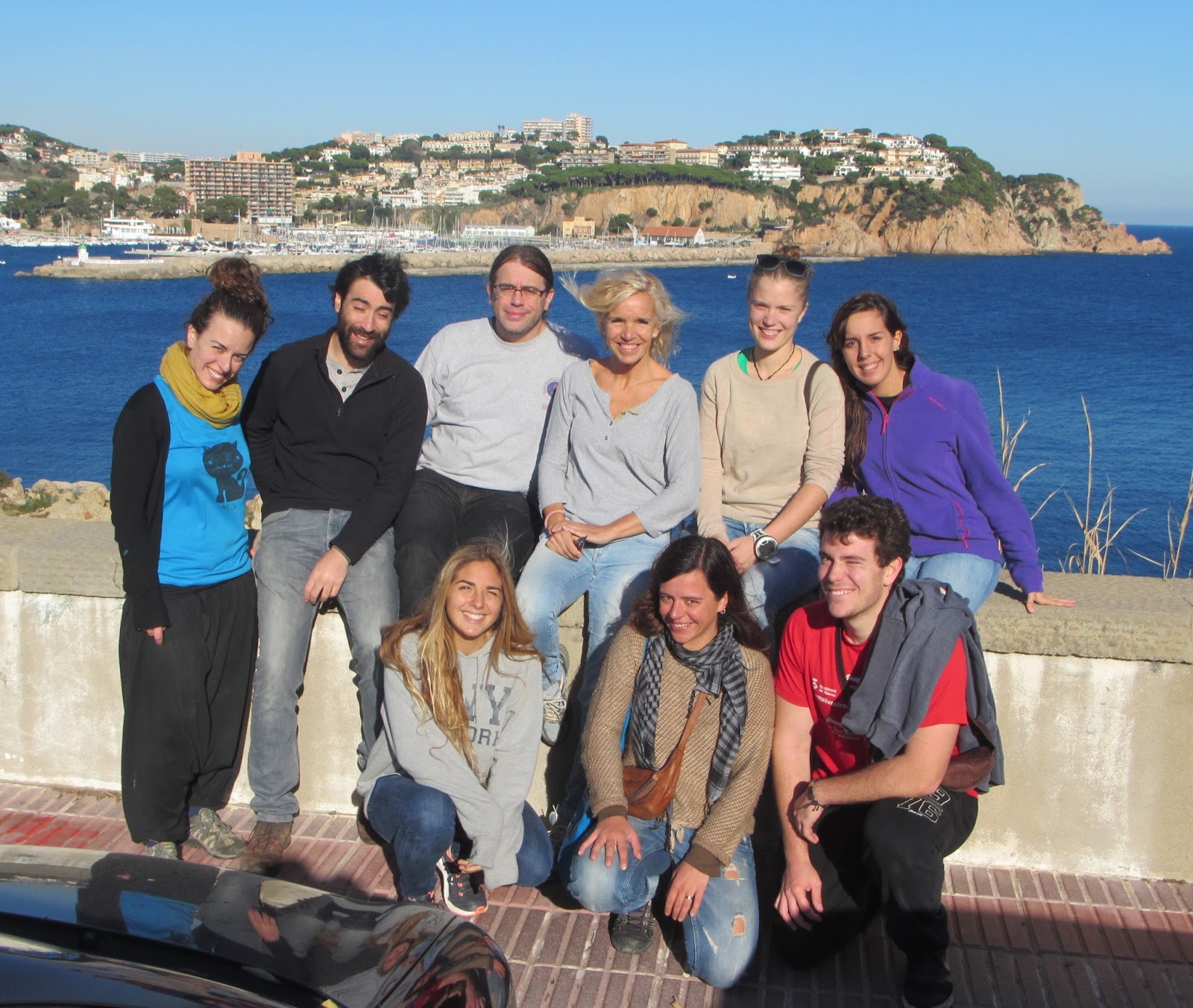
Yesterday we went to Sant Feliu de Guíxols, a locality situated on the Costa Brava. We sampled some sea stars by scuba diving, from surface to 20m depth.

We were very lucky because the day was sunny and the sea was oddly calm. It is a beautiful spot, but usually, at this time of year is very difficult to find such good weather conditions. Moreover, the water was warmer than we expected (18ºC at 12m and 16ºC at 20m depth).