Thursday, February 11, 2016

New paper published: Clavelina oblonga in the Ebro Delta

by Xavier Turon

The article “When invasion biology meets taxonomy: Clavelina oblonga (Ascidiacea) is an old invader in the Mediterranean Sea” by Víctor Ordóñez, Marta Pascual, Margarita Fernández and Xavier Turon is now published online in Biological Invasions.

An oyster culture rope totally covered by colonies of Clavelina oblonga.
In this paper we report the taxonomic status of a marine pest that has recently proliferated in bivalve cultures of the Ebro Delta, smothering mussel spat and causing concern among fishermen. The species was initially identified as Clavelina phlegraea, described in 1929 in Italy and endemic of the Mediterranean. Further morphological and genetic studies, however, have concluded that C. phlegraea is a synonym of the Atlantic species C. oblonga, which has been introduced into the Mediterranean at least 80 years ago, but was known under a different name there. This study illustrates the problems of traditional taxonomy to cope with the global-scale distribution of introduced species.

We have also monitored growth and reproductive cycles of C. oblonga in the Ebro Delta, which were markedly seasonal, with peak abundance and reproduction in summertime, followed by regression in winter. Avoidance of mussel and oyster seeding during late summer and early autumn can readily reduce the damage caused by this species.

Tuesday, January 26, 2016

New paper published

by Xavier Turon

New paper published in Frontiers in Zoology: “Feeding cessation alters host morphology and bacterial communities in the ascidian Pseudodistoma crucigaster”, by Susanna López-Legentil, Xavier Turon and Patrick M. Erwin.

This article is the result of yet another collaboration between the projects ChallenGen and MarSymbiOmics. We have coupled electron microscopy and 16S rRNA gene tag pyrosequencing to investigate the bacterial communities associated with the colonial ascidian Pseudodistoma crucigaster, a species endemic to the Mediterranean Sea that has a life cycle with two phases: actively-filtering (active) and non-filtering (resting) forms.

Active (A) and resting (B) colonies of Pseudodistoma crucigaster. The active form has functional siphonal apertures for filtering water, while the resistance form has all apertures sealed by a glassy cuticle.
Resting colonies exhibited a reduced branchial sac (feeding apparatus) and a thickened cuticle. Electron microscope images also suggested higher abundance of colonizing microorganisms on surfaces of resting colonies. Accordingly, bacterial sequences associated with environmental sources (sediment and biofilms, >99 % similarity) were detected exclusively in resting colonies. Bacterial communities of P. crucigaster colonies (active and resting) were dominated by 3 core taxa affiliated (>94 % similarity) with previously described symbiotic Alphaproteobacteria in marine invertebrates. Shifts in rare bacteria were detected when ascidians entered the resting phase, including the appearance of strictly anaerobic lineages and nitrifying bacterial guilds.

These findings suggest that physical (thickened cuticle) and metabolic (feeding cessation) changes in host ascidians have cascading effects on associated bacteria, where modified oxygen concentrations and chemical substrates for microbial metabolism may create anaerobic microhabitats and promote colonization by environmental microorganisms.

Network of bacterial OTUs in three active and three resting samples of Pseudodistoma crucigaster, with edges coded by specificity.


Thursday, January 21, 2016

Master Thesis of Manuel Orobitg presented!

by Xavier Turon

In November, 2015, Manuel Orobitg, student of the Master of Ocenagropahy and Management of the Marine Environment at the University of Barcelona, presented his MSc Thesis “Morphology vs metabarcoding. A comparison of techniques for biodiversity assessment in Maërl beds”, supervised by Xavier Turon, Creu Palacin and Owen Wangensteen. This Thesis reported results from the Metabarpark project, with which the ChallenGen project is closely collaborating.

Sampling of the Maërl community in Islas Cíes.
Assortment of crustaceans from the 1 mm fraction.
In this study, Manuel analysed morphologically samples collected at the same time as the ones for the genetic studies in the detritic bottoms of Islas Cies and Cabrera Archipelago. He focused his analyses on three major groups: polychaetes, crustaceans, and molluscs. He identified at the lowest level possible, with the help of taxonomists (a big thanks goes to Daniel Martin and Lídia Delgado) the species present in the 10 mm and 1 mm filtrates, and obtained biomass values by weight. The morphological analyses found 77, 45, and 44 morphospecies of polychaetes, crustaceans, and molluscs, respectively, while the genetic analyses yielded 182, 245, and 70 MOTUs, respectively, for the same size fractions. Thus, metabarcoding allowed the determination of a higher diversity, but the taxonomic precision attained was higher with morphology. On the other hand, all structural parameters (biomass dominance curves, alpha- and beta-diversity patterns) were markedly different between the metabarcoding and the morphology datasets, indicating that both methods capture different aspects of the biodiversity structure present. The morphological datasets tended to be quantitatively dominated by a few species, while metabarcoding found a more even distribution of biomass of the dominant MOTUs.

Thursday, January 14, 2016

Starfish telomeres on a radio interview

by Alex Garcia

The starfish Coscinasterias tenuispina has the ability to reproduce sexually and asexually by fission, and many populations are even maintained by only asexual reproduction. One of our issues was to investigate if asexual populations can be maintained indefinitely. Our findings revealed that the starfish elongates their telomeres after fission, regenerating their DNA. Telomeres are repetitive sequences at the caps of chromosomes and are correlated with the age of individuals, therefore, in some point of view; the starfish have a mechanism to rejuvenate themselves.

Different media has been interested in this finding after its publication in Heredity. Among them, the radio program “Al otro lado del espejo” in which I participated last week.


Monday, December 21, 2015

Video contest winners!

by Maria Casso

Last week, on December 17th, was the award ceremony of the I Video Contest Comas i Solà organised by the UB. I participated in this contest with a video about my research.

There were three categories: "the best video", "the most watched video on youtube", "the most original video". I am very proud to say that my video resulted to be the winner in the category "most original video"! During the ceremony, we could saw the three videos.

Thanks to the UB Divulga for organising the contest. I hope next year it will be more participants and even more quality. I think it is a nice way to divulge science and research!


Friday, November 27, 2015

Seminar: DNA Metabarcoding

by Maria Casso

Yesterday, Xavier Turon and Owen Wangensteen participated at the seminar "DNA Metabarcoding", organised by the Biodiversity Research Institute (IRBio). DNA metabarcoding is a method to assess biodiversity which combines DNA based identification and next generation sequencing, and it can have several applications. The aim of the seminar was to show the potencial and limitations of the method.

The first lecture was Xavier's and it was an introduction about the impediments of taxonomy and how can metabarcoding methods contribute to assess biodiversity. After him, Owen talked about the specific case of metabarcoding of hard bottom marine communities. He also explained the few but critical stages of the pipeline were there isn't a consensus among scientists. It is really awesome to watch live how a new method is developing and be part of it.

The seminar took place at the School of Biology (UB). Many researchers and students attended, and some interesting questions came out. It was dense but also clarifying and motivating.


Wednesday, November 18, 2015

Sea stars, Sampling & Sun

by Maria Casso

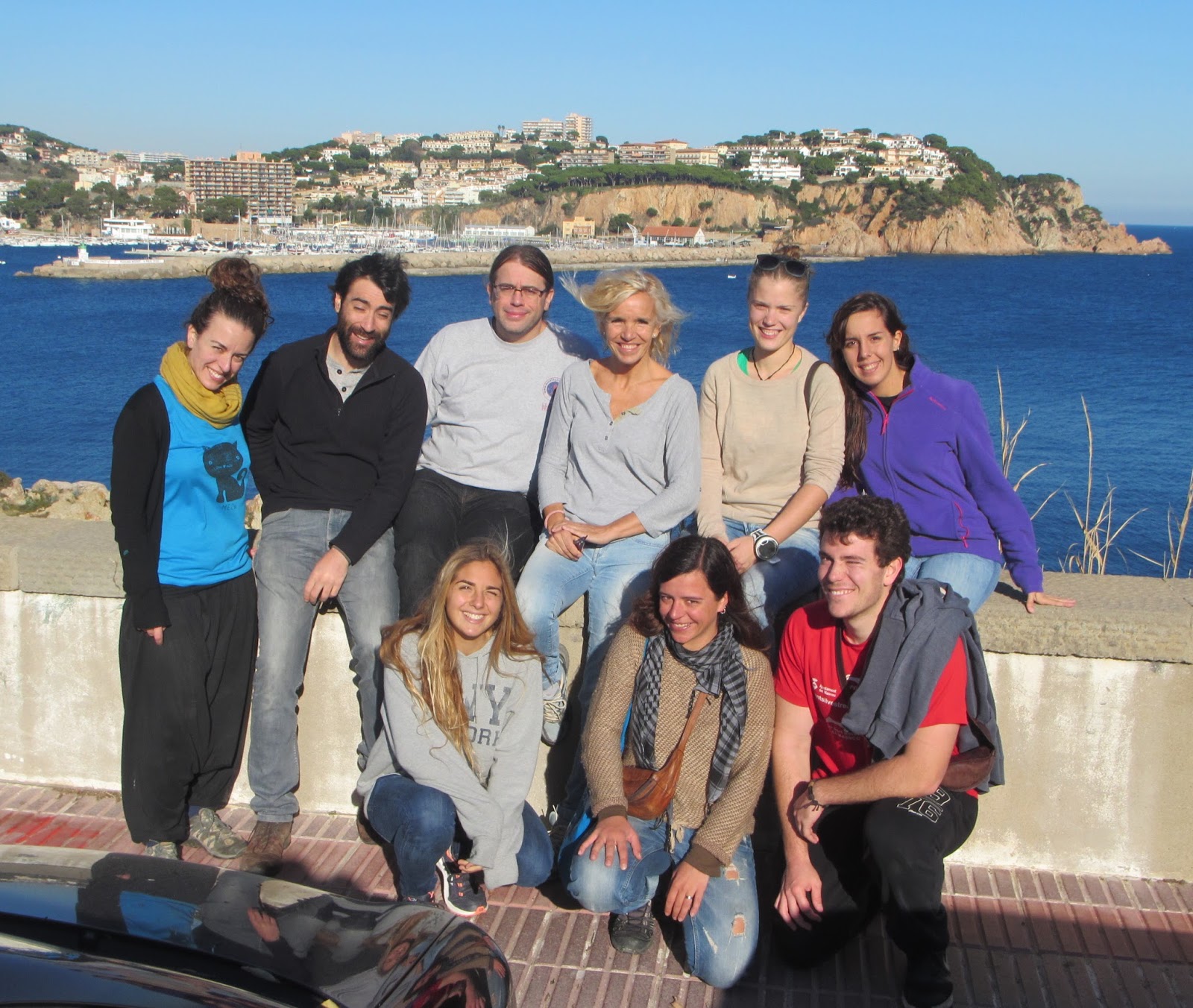
Yesterday we went to Sant Feliu de Guíxols, a locality situated on the Costa Brava. We sampled some sea stars by scuba diving, from surface to 20m depth.

We were very lucky because the day was sunny and the sea was oddly calm. It is a beautiful spot, but usually, at this time of year is very difficult to find such good weather conditions. Moreover, the water was warmer than we expected (18ºC at 12m and 16ºC at 20m depth).


Friday, November 6, 2015

Lectures at the Course “New Technologies applied to the control and monitoring of invasive species”

by Xavier Turon

In October, 19 to 23, the National Parks Autonomous Agency (OAPN) organised a course on new technologies applied to the study of invasive species in Vigo (Galicia). This course was attended by staff, technicians, and rangers of the National Parks in Spain.

I was invited to give a lecture about “Genetic tools and invasive species”. It was an enjoyable experience, with interested audience that posed clever questions... and of course it was an occasion to enjoy good shellfish “mariscada” typical of Galicia’s gastronomy.

The Cíes Islands, part of the National Park of the Atlantic Islands in whose facilities the course was given. The ChallenGen project, in collaboration with the Metabarpark project, has been working on the benthic communities of these Islands.

Thursday, November 5, 2015

New paper published: Deep-sea, deep-sequencing: metabarcoding extracellular DNA from sediments of marine canyons

Getting sediment samples from a multicorer device.
by Xavier Turon

Another article with results from the ChallenGen Project is now published:

Guardiola M, Uriz MJ, Taberlet P, Coissac E, Wangensteen OS, Turon X. 2015. Deep-sea, deep-sequencing: metabarcoding extracellular DNA from sediments of marine canyons. PLoS One 10(10): e0139633. doi:10.1371/journal.pone.0139633

This is our first paper about the metabarcoding of marine communities. In this article we focus on deep-sea sedimentary communities. Samples were collected during the DOSMARES and INDEMARES projects from canyons and adjacent areas in the Catalan and Balearic Islands coasts.

This is the abstract of the article:

Marine sediments are home to one of the richest species pools on Earth, but logistics and a dearth of taxonomic work-force hinders the knowledge of their biodiversity. We characterized α- and β-diversity of deep-sea assemblages from submarine canyons in the western Mediterranean using an environmental DNA metabarcoding. We used a new primer set targeting a short eukaryotic 18S sequence (ca. 110 bp). We applied a protocol designed to obtain extractions enriched in extracellular DNA from replicated sediment corers. With this strategy we captured information from DNA (local or deposited from the water column) that persists adsorbed to inorganic particles and buffered short-term spatial and temporal heterogeneity. We analysed replicated samples from 20 localities including 2 deep-sea canyons, 1 shallower canal, and two open slopes (depth range 100-2,250 m). We identified 1,629 MOTUs, among which the dominant groups were Metazoa (with representatives of 19 phyla), Alveolata, Stramenopiles, and Rhizaria. There was a marked small-scale heterogeneity as shown by differences in replicates within corers and within localities. The spatial variability between canyons was significant, as was the depth component in one of the canyons where it was tested. Likewise, the composition of the first layer (1 cm) of sediment was significantly different from deeper layers. We found that qualitative (presence-absence) and quantitative (relative number of reads) data showed consistent trends of differentiation between samples and geographic areas. The subset of exclusively benthic MOTUs showed similar patterns of β-diversity and community structure as the whole dataset. Separate analyses of the main metazoan phyla (in number of MOTUs) showed some differences in distribution attributable to different lifestyles. Our results highlight the differentiation that can be found even between geographically close assemblages, and sets the ground for future monitoring and conservation efforts on these bottoms of ecological and economic importance.

Multidimensional Scaling (MDS) plots showing the differentiation found between the zones studied (BC, Blanes Canyon; OS, Blanes Open Slope; CC, Cap de Creus Canyon; MC, ;Menorca Canal; ST, Serra de Tramuntana Slope).

Wednesday, November 4, 2015

Monitoring invasive ascidians at Ebro Delta

A nice view of the bivalve culture area.
by Maria Casso

Today we went to the Ebro Delta, for monitoring the invasive ascidians at the oyster and mussel culture structures. After a week of stormy days, we had a sunny and calm monitoring day.

We want to thank the Institute of Food and Agricultural Research and Technology (IRTA) for providing the boat and skipper and collaborate in this monitoring.


Víctor Ordóñez writting down the observations.
Maria Casso and Jose Luís Costa (IRTA).