Friday, November 27, 2015

Seminar: DNA Metabarcoding

by Maria Casso

Yesterday, Xavier Turon and Owen Wangensteen participated at the seminar "DNA Metabarcoding", organised by the Biodiversity Research Institute (IRBio). DNA metabarcoding is a method to assess biodiversity which combines DNA based identification and next generation sequencing, and it can have several applications. The aim of the seminar was to show the potencial and limitations of the method.

The first lecture was Xavier's and it was an introduction about the impediments of taxonomy and how can metabarcoding methods contribute to assess biodiversity. After him, Owen talked about the specific case of metabarcoding of hard bottom marine communities. He also explained the few but critical stages of the pipeline were there isn't a consensus among scientists. It is really awesome to watch live how a new method is developing and be part of it.

The seminar took place at the School of Biology (UB). Many researchers and students attended, and some interesting questions came out. It was dense but also clarifying and motivating.


Wednesday, November 18, 2015

Sea stars, Sampling & Sun

by Maria Casso

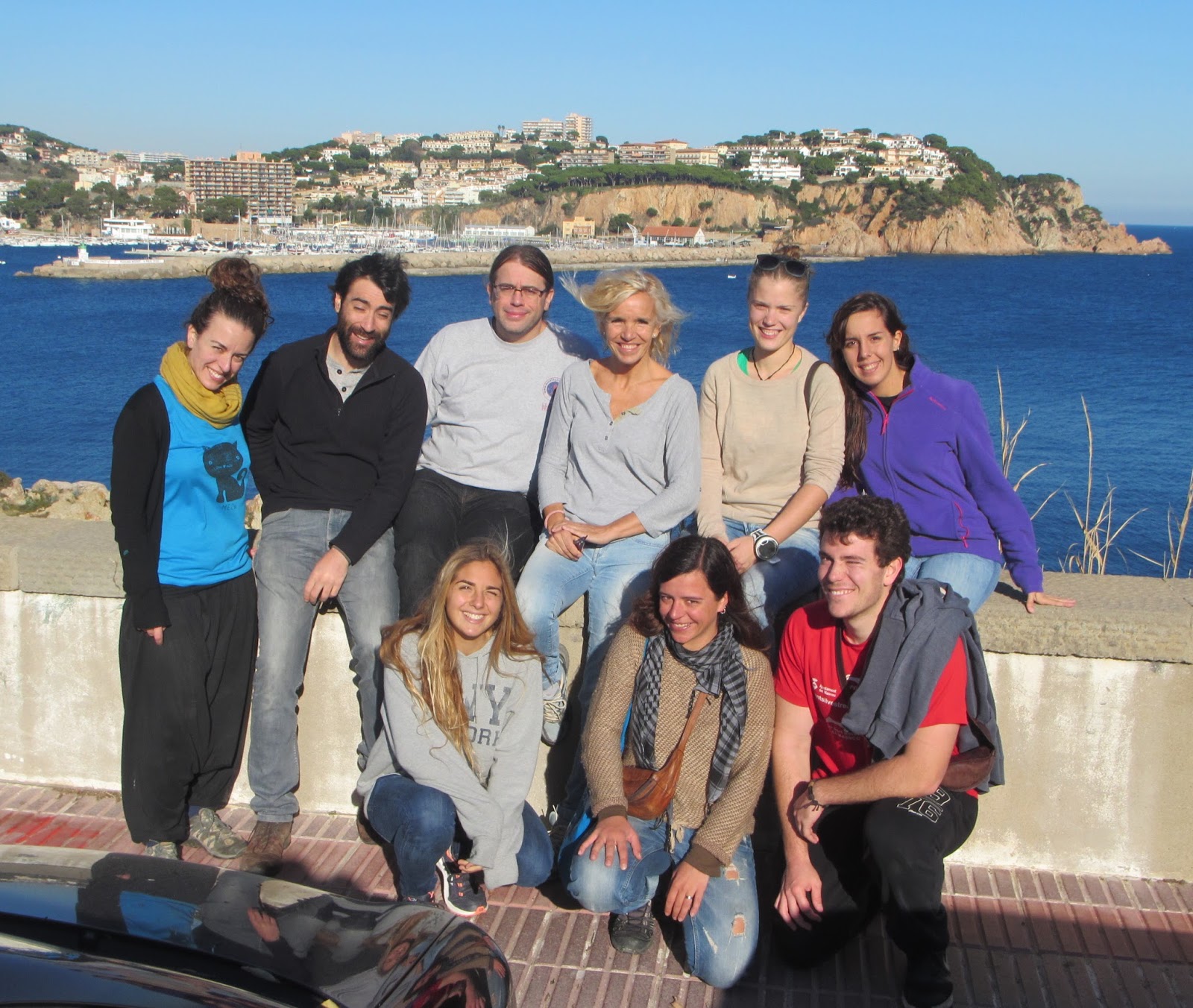
Yesterday we went to Sant Feliu de Guíxols, a locality situated on the Costa Brava. We sampled some sea stars by scuba diving, from surface to 20m depth.

We were very lucky because the day was sunny and the sea was oddly calm. It is a beautiful spot, but usually, at this time of year is very difficult to find such good weather conditions. Moreover, the water was warmer than we expected (18ºC at 12m and 16ºC at 20m depth).


Friday, November 6, 2015

Lectures at the Course “New Technologies applied to the control and monitoring of invasive species”

by Xavier Turon

In October, 19 to 23, the National Parks Autonomous Agency (OAPN) organised a course on new technologies applied to the study of invasive species in Vigo (Galicia). This course was attended by staff, technicians, and rangers of the National Parks in Spain.

I was invited to give a lecture about “Genetic tools and invasive species”. It was an enjoyable experience, with interested audience that posed clever questions... and of course it was an occasion to enjoy good shellfish “mariscada” typical of Galicia’s gastronomy.

The Cíes Islands, part of the National Park of the Atlantic Islands in whose facilities the course was given. The ChallenGen project, in collaboration with the Metabarpark project, has been working on the benthic communities of these Islands.

Thursday, November 5, 2015

New paper published: Deep-sea, deep-sequencing: metabarcoding extracellular DNA from sediments of marine canyons

Getting sediment samples from a multicorer device.
by Xavier Turon

Another article with results from the ChallenGen Project is now published:

Guardiola M, Uriz MJ, Taberlet P, Coissac E, Wangensteen OS, Turon X. 2015. Deep-sea, deep-sequencing: metabarcoding extracellular DNA from sediments of marine canyons. PLoS One 10(10): e0139633. doi:10.1371/journal.pone.0139633

This is our first paper about the metabarcoding of marine communities. In this article we focus on deep-sea sedimentary communities. Samples were collected during the DOSMARES and INDEMARES projects from canyons and adjacent areas in the Catalan and Balearic Islands coasts.

This is the abstract of the article:

Marine sediments are home to one of the richest species pools on Earth, but logistics and a dearth of taxonomic work-force hinders the knowledge of their biodiversity. We characterized α- and β-diversity of deep-sea assemblages from submarine canyons in the western Mediterranean using an environmental DNA metabarcoding. We used a new primer set targeting a short eukaryotic 18S sequence (ca. 110 bp). We applied a protocol designed to obtain extractions enriched in extracellular DNA from replicated sediment corers. With this strategy we captured information from DNA (local or deposited from the water column) that persists adsorbed to inorganic particles and buffered short-term spatial and temporal heterogeneity. We analysed replicated samples from 20 localities including 2 deep-sea canyons, 1 shallower canal, and two open slopes (depth range 100-2,250 m). We identified 1,629 MOTUs, among which the dominant groups were Metazoa (with representatives of 19 phyla), Alveolata, Stramenopiles, and Rhizaria. There was a marked small-scale heterogeneity as shown by differences in replicates within corers and within localities. The spatial variability between canyons was significant, as was the depth component in one of the canyons where it was tested. Likewise, the composition of the first layer (1 cm) of sediment was significantly different from deeper layers. We found that qualitative (presence-absence) and quantitative (relative number of reads) data showed consistent trends of differentiation between samples and geographic areas. The subset of exclusively benthic MOTUs showed similar patterns of β-diversity and community structure as the whole dataset. Separate analyses of the main metazoan phyla (in number of MOTUs) showed some differences in distribution attributable to different lifestyles. Our results highlight the differentiation that can be found even between geographically close assemblages, and sets the ground for future monitoring and conservation efforts on these bottoms of ecological and economic importance.

Multidimensional Scaling (MDS) plots showing the differentiation found between the zones studied (BC, Blanes Canyon; OS, Blanes Open Slope; CC, Cap de Creus Canyon; MC, ;Menorca Canal; ST, Serra de Tramuntana Slope).

Wednesday, November 4, 2015

Monitoring invasive ascidians at Ebro Delta

A nice view of the bivalve culture area.
by Maria Casso

Today we went to the Ebro Delta, for monitoring the invasive ascidians at the oyster and mussel culture structures. After a week of stormy days, we had a sunny and calm monitoring day.

We want to thank the Institute of Food and Agricultural Research and Technology (IRTA) for providing the boat and skipper and collaborate in this monitoring.


Víctor Ordóñez writting down the observations.
Maria Casso and Jose Luís Costa (IRTA).


Saturday, October 31, 2015

Video: Alien Species VS. Genomics

https://www.youtube.com/watch?v=53eIgJtLcLQ
by Maria Casso

The University of Barcelona (UB) organises for the first time a short film contest that allows researchers describing the scientific studies they develop to the general public.

I decided to participate in this contest as I'm a PhD student at the UB.

You can watch it here.

I hope you like it!

Tuesday, October 13, 2015

Population genetics with R

by Maria Casso

Visit at the Centre de Restautació i Interpretació Paleontològica (CRIP).
Last week, I participated in a very interesting course: Exploratory Methods for Population Genetics Using R, organized by Transmitting Science. The course took place in Hostalets de Pierola (Barcelona), from 5th to 9th October. We learnt about some interesting R packages from their very authors, Dr. Emmanuel Paradis and Dr. Thibaut Jombart, who are excellent teachers.

It was intense but also fun as I had the opportunity to play with my own data with the new R packages, with the support and advice of the teachers. Moreover, it was very interesting to meet people working on similar data type than me so with similar problems, as we could discuss about it and maybe found some solutions.

Thanks to the organization, the teachers and the participants!

3rd ChallenGen meeting!

The 2nd October, we had a meeting in Blanes, with most of the members of the group. Besides the updates from everyone, we could discuss about some methods to analyse GBS data, and listen to an interesting seminar about metabarcoding by Owen Wangensteen.


Monday, September 14, 2015

New article of ChallenGen accepted!

by Xavier Turon

Another article including results from ChallenGen has been accepted for publication in Frontiers in Microbiology. The title of the paper is “Temporal stability of bacterial symbionts in a temperate ascidian” by López-Legentil S, Turon X, Espluga R, Erwin PM.

This article is the result of collaborative work between the projects ChallenGen and MarSymbiOmics (CTM2013-43287). The goal of MarSymbiOmics is the study of symbioses of invertebrates from a molecular perspective. It is only natural that we coordinate efforts… We are more focused on the genetics of the host, while the MarSymbiOmics team is interested in the genetics of the microbiome.

A colony of Didemnum fulgens in the monitoring site at L’Escala (Catalan coast, NW Mediterranean).
In this particular study we have monitored the population of an ascidian species, Didemnum fulgens, over an annual cycle. Its pattern of growth and reproduction has been published a while ago (López-Legentil S, Erwin PM, Velasco M, Turon X. 2013. Growing or reproducing in a temperate sea: optimization of resource allocation in a colonial ascidian, Invertebrate Biology 132:69-80).

Now we publish the results of the temporal changes in microbiome composition of that same population using terminal restriction fragment length polymorphism (T-RFLP) and clone library analyses based on the16S rRNA gene. The overall bacterial community in D. fulgens had a distinct signature from the surrounding seawater and was stable over time and across seasonal fluctuations in temperature. Bacterial symbionts were also observed in the inner tunic of larvae of D. fulgens. Our results suggest that, as seen for sponges and corals, some species of ascidians host stable and unique bacterial communities that are at least partially inherited by their progeny by vertical transmission.

Soon available in Open Access!!!

Monday, August 31, 2015

The importance of being barcoded

by Owen S. Wangensteen

When, back in 2003, Canadian biologist Paul Hebert proposed the creation of a public database of short sequences aimed at identifying biological specimens by means of just these small sequences (DNA-barcodes), he did not find the unanimous response anyone would expect nowadays. Detractors were many and they actually made a lot of scientific noise. In fact, as Laurence Packer once pointed, scientific papers published from 2004 to 2007 criticizing and opposing DNA-barcoding were more numerous (and had more citations) than papers written by the first “barcoders” who embraced the idea. Then, a miracle occurred: as the public databases grew, DNA-barcoding started to prove its utility in a myriad of forms. From long-disputed basic taxonomy issues to medico-legal forensics, passing through river ecology, agricultural sciences, control of disease outbreaks, food security or biodiversity conservation, all took advantage of DNA-barcoding in ways only a few would have dreamt of some years before.

The reticences were mainly based in some false concerns and a few ancestral fears. Morphological taxonomists argued that no small-sequence could replace their meticulous, morphological observations and thorough interpretations, while internally fearing to lose their jobs. Geneticists argued that genomes were way too complex to be reduced to just a three-hundred base-pairs sequence. Ecologists thought that molecular methods were too expensive and beyond their field of expertise. All of them were basically wrong.

DNA-barcoding does not plan (and is never going) to replace taxonomists. At its best, DNA-barcoding is meant to replace traditional identification keys (which were probably bound to disappear anyway!). Identification keys are usually a nightmare even for expert taxonomists and are completely useless for specious groups including thousands or tens of thousands of species. DNA-barcoding will only facilitate the work of taxonomists, which are still needed (in fact, more needed than ever) for identifying problematic specimens. Given the estimations for the global number of species and the current description rate of new species, we will need taxonomists, at least, for the next 500 years, or probably much longer. This is more than most scientists working in other areas of knowledge could bet.

It is true that genomes of non-model organisms are large, complex, gigantic monsters waiting to be tamed. But the fact is that all you need for unambiguously identify the species where a specimen belongs is a fragment of just a few hundreds base-pairs of a highly variable genomic region (in most cases, just 200 base-pairs will do!). Mitochondrial DNA (and, specifically, the cytochrome oxidase I gene, COI) has proven its power to achieve this task in many groups of organisms (including animals; other genes are most used for green plants or fungi). If you need your sequences just for identification purposes, all you need is to sequence but 200 base-pairs of COI. Fast and easy.

And unexpensive. Sequencing costs have done nothing but plummeting over the last three decades and they are predicted to keep decreasing in a month-to-month basis. Astounding sequencing technologies that grew up under the big umbrella of Human Genome Project have already arrived to average-sized laboratories. Nowadays, DNA-barcoding of an unknown specimen is something that a freshman biology student could perform during his/her first lab course. Costs and complexity are no longer valid excuses.

I recently understood the pivotal importance of barcoding (i.e. the urgent need for getting the sequences from as many different species as you can and depositing them in a public database as soon as possible) when I started analyzing the data we got from bulk-sequencing environmental samples collected in shallow marine hard-bottom communities of selected marine reserves in Spain. This kind of research is crucial to understand how marine communities are changing (and they are changing indeed, probably at a faster pace than we use to think). We need to sample these communities and characterize them as soon as possible, if we want to be able to detect any changes in the near future, before it's too late. The sensible way to do this is by metabarcoding them. That is: get the sample inside a bag, blend it with a kitchen blender, extract the DNA of every organism present in the mixture, use this DNA to amplify a useful genetic marker (COI is the usual choice), and then try to match the millions of sequences you get to the current contents of public barcoding databases, in order to identify the organisms that are present in your samples (and probably their abundances, but that's another story I will be writing some other day). The first steps of this procedure proved to be surprisingly easy. Notably, it is the last identification step which is currently limiting the utility of this technique. We have literally millions of different COI sequences, representing all the biodiversity hidden in our samples, but we are able to identify (give a species name) just a small percentage of these sequences. Marine barcoding databases are not as developed as terrestrial ones. Small and microscopic organisms are much more underrepresented in the databases than big, macroscopic ones. A surprisingly high percentage of marine diversity is yet unknown, even for shallow ecosystems in the Mediterranean or temperate Atlantic European shores, which have been extensively studied by marine biologists, at least since Aristotle.

If we want to begin to understand the biodiversity changes which are happening now in our beloved marine ecosystems, we really need to undertake the titanic task of sequencing the DNA-barcodes of as many marine species as possible, and release the data to our public databases. I am confident that metabarcoding will become the main tool of marine ecologists in the next few years. We need to extract its full power as soon as possible by expanding our databases and filling the main gaps. This is no task for an individual or a small group of people. Given the overwhelmingly high number of different marine species, this is a task for several hundreds of marine taxonomists, working across the World, identifying species in their different groups of expertise, sequencing data, curating taxonomies, releasing data, and waiting for no bigger reward on these data release but contributing to help other marine biologists in building the greatest and most useful marine taxonomy enterprise of all time.

As Harry Truman once said, it is amazing what you can accomplish if you do not care who gets the credit.

Comparing DNA-barcoding vs environmental-DNA metabarcoding approaches to biodiversity monitoring. In DNA-barcoding, a single individual is analyzed, whereas metabarcoding can analyze whole communities by using the power of next-generation sequencing technologies.


References:
Hebert et al. 2003. Biological identifications through DNA barcodes. Proc. R. Soc. Lond. B 270, 313–321. doi: 10.1098/rspb.2002.2218